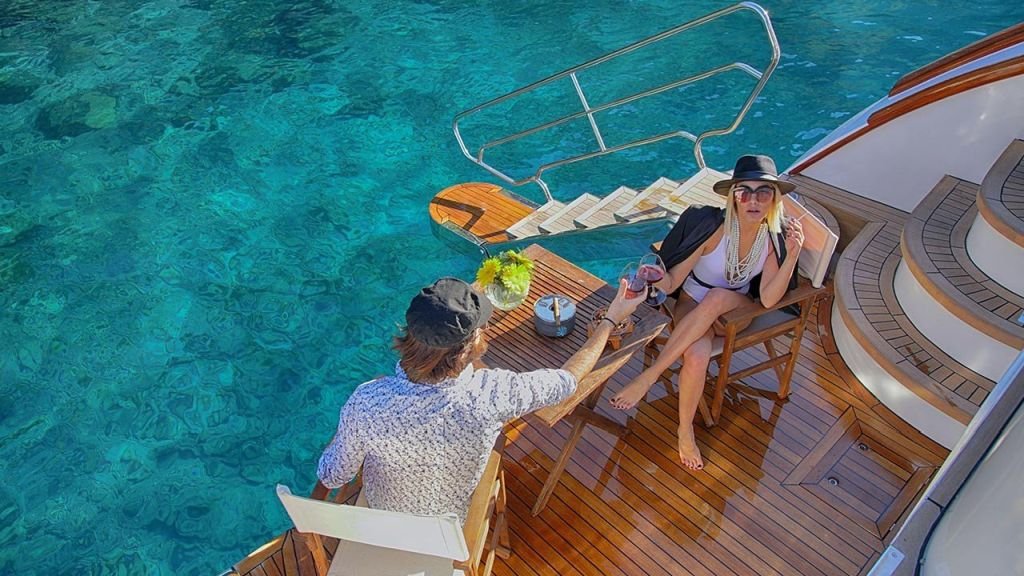
One of the great pleasures of a gulet charter is the lack of a fixed schedule. Broadly, though, a typical day unfolds something like this:
Dawn to 9 AM: The boat is still at anchor in a quiet bay. The chef has risen early to prepare breakfast — a spread of fresh bread, local cheeses, honey, olives, sliced tomatoes, cucumbers, and eggs prepared to order. Coffee and tea appear as guests surface.
9–10 AM: Your captain discusses the day’s options over breakfast. Do you want to push on to an archaeological site? Stay another few hours for one final swim in this perfect cove? Visit the village market in a nearby fishing harbour? The choice is entirely yours.
Mid-morning: The gulet weighs anchor and begins the day’s cruise — typically 3–4 hours of sailing, either under engine or, with a fair wind, under canvas. Deck chairs are populated, music plays softly, and the crew serves fresh juices and iced water.
Midday: The gulet drops anchor in a new bay. Lunch is served on the aft deck — usually a feast of cold mezze dishes, grilled vegetables, freshly caught fish, stuffed vine leaves, hummus, and warm bread. Then the stern platform lowers into the sea, kayaks and paddleboards are deployed, and the afternoon belongs entirely to swimming, snorkelling, and pure leisure.
Late afternoon: Perhaps a visit ashore — into a whitewashed village, to explore Lycian tomb carvings in the cliff faces, or a short hike to a clifftop viewpoint. Or simply remain on the sun deck as the light turns amber and the crew begins preparing the evening meal.
Sunset & evening: Sundowners on deck as the sky shifts through crimson and violet. Dinner is a long, convivial affair under the stars — fresh fish grilled over charcoal, slow-braised lamb, seasonal vegetables, local wine. The night sky over the Aegean, unpolluted by city lights, is extraordinary.
Along the southwestern coast of Turkey, known as the “Turquoise Coast,” a unique sound echoes through the shipyards of Bodrum, Marmaris, and Antalya: the rhythmic tap of adzes shaping massive timber frames. This is the sound of gulet building—a centuries-old maritime tradition that has evolved into a thriving, world-renowned industry.
The Turkish gulet (originally gulet or gullet) is more than a boat; it is an icon of leisure, a floating hotel, and a testament to master craftsmanship. Today, Turkey builds more wooden hulls over 24 meters (79 feet) than any other country in the Mediterranean. This article explores how these beautiful vessels go from forest to sea.
Part 1: A Brief History – From Fishing to Luxury
The gulet’s origins are humble. Historically, these were double-ended, beamy wooden boats used by sponge divers and fishermen in the Aegean Sea. They were working vessels—slow, sturdy, and designed to handle heavy loads.
The Transformation (1980s-1990s): As Turkish tourism boomed, entrepreneurs in Bodrum saw an opportunity. They converted old fishing gulets into small passenger vessels, adding cabins, a galley, and a wide aft deck for dining. The “Bodrum Gulet” was born.
The Golden Age (2000s-Present): Demand exploded. Charter companies in Croatia, Greece, and the Caribbean wanted Turkish-built gulets. Shipyards shifted from converting old boats to building custom, luxury yachts from scratch. Today, a modern gulet rivals any fiberglass production yacht in comfort, often featuring jacuzzis, stabilizers, and fine dining interiors.
Part 2: The Materials – Wood Selection
Unlike fiberglass or steel boats, a gulet’s soul is its wood. Turkish shipwrights are obsessive about timber selection.
Primary Woods Used:
Wood Type
Source
Use
Why
Iroko
West Africa
Keel, frames, planking
Extremely durable, rot-resistant, and dense. The gold standard.
Note on Sustainability: Reputable Turkish yards now use only FSC-certified iroko and mahogany. Illegal logging is a serious concern, and top builders maintain strict supply chain documentation.
The “Laminated Frame” Revolution
Traditionally, gulets used naturally curved “compass” timbers (oak roots) for frames. These are rare and expensive today. Modern Turkish builders now use laminated frames—thin layers of iroko or okoume glued together under hydraulic pressure and bent into shape. These are actually stronger than natural timber because the grain follows the curve perfectly.
Part 3: The Construction Process – Step by Step
Building a 30-meter gulet takes 12 to 24 months, depending on complexity. Here is the typical timeline and process.
Step 1: The Design & Molds
Modern gulets are not built freehand. Naval architects (many based in Istanbul or Antalya) produce detailed CAD drawings. The yard builds a full-scale “mold” or “temporary framework” (called a tüp in Turkish) on the slipway. This ensures symmetry.
Step 2: The Keel Laying
The backbone of the boat. A laminated iroko or oak keel is laid—often measuring 40cm x 25cm in cross-section and running the full length (24m-45m). This is a ceremonial moment in Turkish yards, sometimes marked with a small blessing.
Step 3: Frames (Ribbons) Installation
Laminated frames are bent over the keel, spaced roughly 40-60cm apart. Each frame is temporarily braced. For a 30m gulet, you are looking at 50-70 frames. This creates the skeleton.
Step 4: Planking (The Hull)
This is the most labor-intensive phase. Planks of iroko or mahogany (typically 5cm thick, 15-20cm wide) are steam-bent, clamped to the frames, and fastened with bronze screws or silicon bronze ring nails (never steel—steel rusts and stains wood).
Carvel Planking: The standard method. Planks are laid edge-to-edge with a slight gap (caulked later).
Strip Planking (Modern): Thin strips (2.5cm) are laminated over a mold, creating a monocoque hull. Lighter and more watertight, but less “traditional.”
Step 5: Caulking – The Turkish Specialty
Wooden boats leak if not properly caulked. Turkish caulkers (known as kalafatçı) are revered. They drive cotton or synthetic oakum into the seams between planks using a caulking iron and mallet. Then, they pour hot pitch or specialized silicone-based sealant over the cotton. A well-caulked gulet will swell when launched, becoming virtually watertight.
Step 6: Interior & Decking
While the hull cures, carpenters build the interior: cabins, galley, saloon. Most Turkish yards use marine plywood faced with fine veneers (mahogany, teak, cherry) for weight savings. The deck is laid with teak planking over a waterproof membrane.
Step 7: Systems Installation
Modern gulets are complex machines. Yards install:
Engines: Typically 2 x 400hp to 2 x 1000hp (Cummins, MAN, or Turkish-made TUMOSAN).
Generators: 2 x 30kW-80kW for hotel loads.
Air conditioning: Chilled water systems running throughout.
Hydraulic stabilizers: Zero-speed stabilizers (CMC or Sleipner) are now standard on gulets over 30m.
Step 8: Launch & Outfitting
The boat slides into the water (often sideways on marine railways). Then comes masting, rigging (usually two masts, sometimes three), painting (Coppercoat or antifouling), and final commissioning.
Part 4: Major Gulet Building Centers in Turkey
Not all Turkish yards are equal. Here is where the best g ulets come from:
Bodrum (The Capital)
Reputation: The spiritual home. Yards here emphasize traditional aesthetics and “Bodrum-style” sheer (the upward curve at the bow).
Key Yards: Bodrum Shipyard, Sarp Yachts (now builds superyachts but started with gulets), Kocabaş Yachting.
Specialty: Charter gulets in the 24m-35m range.
Marmaris & İçmeler
Reputation: Industrial scale. Marmaris yards produce high-volume, production-style gulets faster and cheaper than Bodrum.
Key Yards: Marmaris Shipyard, Yesil Marmaris.
Specialty: Budget-conscious builds and steel-hulled “gulets” (a controversial hybrid).
Antalya (Free Zone)
Reputation: The “factory.” The Antalya Free Zone hosts massive covered sheds building gulets for export to the UAE, Qatar, and Russia.
Key Yards: Antalya Shipyard (Alya Marine), Turquoise Yachts (subsidiary).
Specialty: Mega-gulets over 45m, often with steel hulls and wooden superstructures.
Part 5: Steel vs. Wood – The Great Debate
Many modern “gulets” are actually steel-hulled with wooden decks and superstructures. Which is better?
Feature
Traditional Wood (Iroko/Mahogany)
Modern Steel
Aesthetics
Warm, classic, photogenic
Can look “industrial” unless overplanked with wood
Maintenance
High (varnishing, caulking every 2-3 years)
Low (sandblast and paint every 5-7 years)
Weight
Lighter (better fuel economy)
Heavier (needs more power)
Noise/Vibration
Naturally dampening
Requires extensive insulation
Longevity
30-50 years with care
50-80 years (steel doesn’t rot)
Cost
Higher (labor intensive)
Lower (fabrication is faster)
Verdict: Purists insist on full wood. Commercial buyers (charter companies) often choose steel for lower maintenance and longer lifespan. The current trend for vessels over 40m is steel hull + wood superstructure—a hybrid approach.
Part 6: Costs and Pricing (2024-2025)
Building a gulet in Turkey is surprisingly affordable compared to Northern Europe, but prices have risen sharply due to inflation and lumber costs.
Size
Type
Price Range (USD)
Build Time
24m (Standard charter)
Full wood, 2 cabins
1.2M−1.8M
12-16 months
30m (Luxury)
Wood/Steel hybrid, 4 cabins
2.5M−4.0M
16-20 months
40m (Mega-gulet)
Steel hull, 6-8 cabins
6.0M−10.0M+
24-30 months
50m+ (Super gulet)
Full custom
15M−25M+
30-36 months
Additional Costs:
Naval architecture: 50k−150k
Turkish VAT (if staying in Turkey): 20% (avoidable for export)
Delivery to Mediterranean: 50k−150k (on own bottom)
Part 7: Quality Concerns – What to Watch For
Not all Turkish gulets are masterpieces. The industry has suffered from “fly-by-night” yards that cut corners.
Red Flags:
Green wood: Using unseasoned timber that will shrink, crack, and leak.
Steel fasteners: Iron nails rust, staining the wood and causing rot.
Poor caulking: Cotton driven too hard can split planks.
No surveyor: Builders who resist third-party inspections.
Hallmarks of Quality:
Surveyor involvement: A reputable owner hires an independent surveyor during construction.
Lloyd’s Register or RINA class: Some Turkish yards build to classification society standards (rare for wood, but increasing).
Proven track record: Yards that have delivered 20+ boats without litigation.
Part 8: The Future of Gulet Building
The industry is evolving rapidly. Here are three trends shaping the next decade:
1. Hybrid & Electric Propulsion
Several yards (notably Alya Marine in Antalya) are building diesel-electric g ulets. Solar panels on the Bimini top charge batteries, allowing silent anchoring and reduced fuel consumption. A 30m hybrid gulet costs about 20% more upfront but saves $30k/year in fuel.
2. Composite Materials
To reduce maintenance, some builders are replacing wooden decks with synthetic teak (Flexiteek) and using epoxy-sealed hulls instead of traditional pitch caulking. Purists object, but charter operators love the low upkeep.
3. Export to Asia & Middle East
Turkish g ulets are increasingly sold in Dubai, Doha, and Phuket. The warm climates and stable charter markets favor the gulet’s open design. Turkish yards now offer “tropical packages” (larger air conditioning units, UV-resistant varnish).
Conclusion: Is a Turkish-Built Gulet Right for You?
If you dream of a classic wooden yacht with modern amenities, a Turkish gulet is unmatched in value. You will get a custom-built vessel for roughly one-third the price of a comparable Northern European wood yacht (e.g., a Dutch-built steel motor sailor).
However, you must accept the maintenance. Wooden boats demand constant attention—varnishing teak, inspecting caulking, managing humidity below decks. If you want to “set and forget,” buy fiberglass.
For those who appreciate craftsmanship, tradition, and the romance of the Aegean, a gulet built in Bodrum or Antalya is not just a purchase—it is a legacy.
Quick Reference: Top Turkish Gulet Builders
Yard
Location
Specialty
Price Range
Sarp Yachts
Bodrum
Ultra-luxury wood (35m-50m)
8M−20M
Alya Marine
Antalya
Hybrid/steel mega-gulets
6M−15M
Kocabaş Yachting
Bodrum
Traditional charter gulets
1.5M−4M
Marmaris Shipyard
Marmaris
Production wood (value)
1M−3M
Turquoise Yachts
Antalya
Custom steel/wood hybrids
10M−25M
*Disclaimer: Prices and specifications are estimates based on 2024-2025 market conditions. Always engage a marine surveyor and naval architect before commissioning a build.*
Turkey, a nation straddling two continents, is not just a tourist paradise-it is a maritime powerhouse. With coastlines along the Aegean, Mediterranean, and Black Seas, Turkey has become a global hub for shipbuilding, refit, and yachting. Consequently, the yacht brokerage industry in Turkey has matured into a sophisticated, dynamic, and highly competitive market.
Whether you are looking to buy a traditional gulet, a multi-million dollar superyacht, or sell a used motor cruiser, understanding the nuances of Turkish yacht brokerage is essential. Here is everything you need to know.
The Unique Turkish Market: Gulet and Superyachts
Unlike the Mediterranean hubs of France or Italy, which focus heavily on sailing racers and high-volume production motor yachts, the Turkish brokerage market has two distinct pillars:
The Gulet Market: Turkey is the capital of the gulet—a traditional wooden double or triple-masted schooner. These vessels are built primarily in Bodrum, Marmaris, and Antalya. A robust secondary market exists for pre-owned gulets, ranging from 24m to 45m. Brokerage here focuses on condition of wooden hulls, engine hours, and charter potential.
The Superyacht Refit Market: Due to the strong shipbuilding infrastructure in Yalova, Tuzla (Istanbul), and Antalya, many foreign-owned superyachts come to Turkey for refits. Consequently, brokers often list vessels that are “located in Turkey” but registered elsewhere (Cayman Islands, Malta, etc.).
The Legal Landscape: How Brokerage Works in Turkey
Understanding the regulations is critical. Unlike the US, where “brokers” often hold state licenses, Turkey operates under the Ministry of Transport and Infrastructure and Turkish Chamber of Mechanical Engineers (MMO) guidelines.
The “Yetki Belgesi” (Authorization Certificate): A legitimate Turkish yacht broker must have a signed “Authority to Sell” contract from the owner. Without this document, the brokerage is technically illegal.
The General Declaration: For foreign-flagged vessels located in Turkish waters, the sale requires a “General Declaration” to be stamped by the harbor master, effectively changing the vessel’s status.
VAT Considerations: This is the trickiest part. Turkey has high VAT (currently 20% + special consumption tax for large engine vessels). If a boat is in Turkey under a “Temporary Importation” (e.g., a foreign yacht visiting), selling it to a Turkish resident triggers massive tax bills. A good broker knows how to navigate “export sales” (delivering the boat outside Turkish waters) to avoid this.
What Services Do Turkish Yacht Brokers Offer?
Top-tier brokerages in Turkey (such as Bering Yachts Brokerage, Northrop & Johnson Turkey, or local specialists like Ali Sanmarin Yachting) do not just list boats. They provide:
1. Professional Pre-Purchase Inspections (Survey Management)
Turkey has excellent surveyors, but a broker coordinates the “haul-out” (taking the boat out of the water). In shipyards like Kumport (Istanbul) or Marmaris Yacht Marina, brokers arrange for ultrasonic hull thickness testing (critical for steel yachts) or moisture metering (for wooden gulets).
2. Documentation & Flag Transfer
Transferring a vessel from a Turkish “Blue Card” (waste tracking) system to a foreign flag is bureaucratic. Brokers manage the “Transaction Minutes” (Tutanak) needed to deregister a Turkish-flagged vessel.
3. Escrow & Payment Security
Turkish banking regulations require currency control for large sums (over $50k). Brokers often work with “Notary Public” escrow services or bank letters of credit, ensuring the seller gets their Euros/Dollars and the buyer gets a clean title.
The Top Yacht Brokerage Hubs in Turkey
Where you search defines your inventory:
Bodrum: The heart of the gulet trade. If you want a wooden classic, look here. Brokers focus on lifestyle and charter income projections.
Istanbul (Ataköy Marina & Tuzla): The center for high-volume motor yachts (Azimut, Princess, Sunseeker) and mega-yachts over 40m. Most professional corporate brokerages are based in Istanbul.
Antalya (Kemer & Setur Marinas): The “refit alley.” Many distressed or project yachts are sold here “as is” after winter storage. Great for bargain hunters with restoration skills.
Marmaris: A mix of charter gulets and high-performance sailing yachts. Excellent for brokerage of Dutch-built steel yachts.
The Risks: “Commission Sellers” vs. Real Brokers
The Turkish market has a unique pest: the Komisyoncu (unlicensed middleman). These are often marina waiters, taxi drivers, or café owners who claim to know a boat for sale. Do not deal with them.
Real Broker: Has a signed listing agreement, offers sea trials, provides a survey history, and has professional indemnity insurance.
Commission Seller: Asks for a “finder’s fee” upfront. Usually has no access to the owner’s logbook or the vessel’s title deed.
Trends in 2024-2025: The Current State of Play
As of late 2024 and looking into 2025, the Turkish brokerage market is experiencing:
The “Dollar/Euro” Squeeze: Due to Turkish Lira inflation, locals are desperate to convert cash into hard assets (yachts). This has inflated prices for sub-50ft boats.
Russian Buyers: Despite sanctions, a significant number of Russian buyers use Turkish brokerage houses (operating in USD cash) to acquire yachts without returning to their home ports.
Green Transition: Turkish brokers are increasingly asked for “Hybrid” or “Low emission” gulets. New builds are shifting, but the brokerage market for used diesel boats remains strong due to the lack of charging infrastructure.
Steps to Buying a Used Yacht in Turkey via a Broker
Sign a NDA/LOI: Express interest. The broker will share the full specs.
The Offer: You make a written offer (valid for 48-72 hours) with a 10% deposit (PAD – Paying Agent Deposit).
Condition Survey: You pay for the surveyor (2k−5k). The broker coordinates the lift.
Title Search: The broker checks the “Turkish Ship Registry” (Gemi Sicil) for mortgages or liens. (This is free and public in Turkey, unlike many countries).
Closing: You meet at a Notary or Bank. Money changes hands. The broker collects their commission (usually 10% paid by seller, but negotiable).
Conclusion
Yacht brokerage in Turkey is a land of opportunity but requires local navigation. The country offers some of the best value for money in the Mediterranean—particularly for steel-hulled displacement yachts and wooden gulets. However, the regulatory labyrinth of VAT, Temporary Importation, and currency control makes a licensed, professional broker not a luxury, but a necessity.
Vira bismillah (Let go with God’s name)—with the right broker, your Turkish yacht adventure can begin smoothly.
Quick Tips Summary for Buyers:
Always verify the “Authorization Certificate.”
Never pay cash to a middleman without a marina receipt.
Assume the boat needs 10-15% of its purchase price in refit (especially if it’s a wooden gulet).
Check the engine hours against the winter storage logs (Turkish marinas track entry/exit).
Disclaimer: This article is for informational purposes. Laws and tax rates in Turkey change frequently. Always consult a local maritime attorney.