
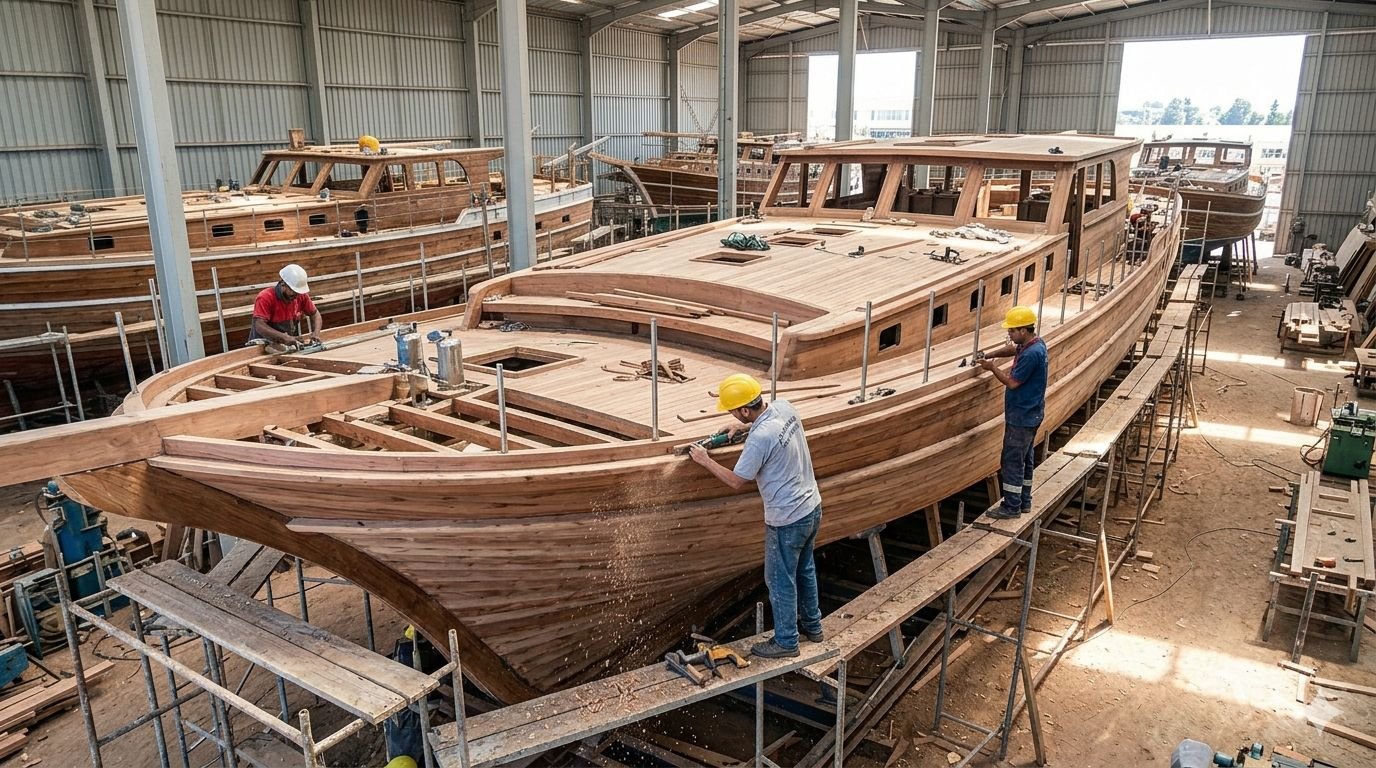
Along the southwestern coast of Turkey, known as the “Turquoise Coast,” a unique sound echoes through the shipyards of Bodrum, Marmaris, and Antalya: the rhythmic tap of adzes shaping massive timber frames. This is the sound of gulet building—a centuries-old maritime tradition that has evolved into a thriving, world-renowned industry.
The Turkish gulet (originally gulet or gullet) is more than a boat; it is an icon of leisure, a floating hotel, and a testament to master craftsmanship. Today, Turkey builds more wooden hulls over 24 meters (79 feet) than any other country in the Mediterranean. This article explores how these beautiful vessels go from forest to sea.
Part 1: A Brief History – From Fishing to Luxury
The gulet’s origins are humble. Historically, these were double-ended, beamy wooden boats used by sponge divers and fishermen in the Aegean Sea. They were working vessels—slow, sturdy, and designed to handle heavy loads.
The Transformation (1980s-1990s): As Turkish tourism boomed, entrepreneurs in Bodrum saw an opportunity. They converted old fishing gulets into small passenger vessels, adding cabins, a galley, and a wide aft deck for dining. The “Bodrum Gulet” was born.
The Golden Age (2000s-Present): Demand exploded. Charter companies in Croatia, Greece, and the Caribbean wanted Turkish-built gulets. Shipyards shifted from converting old boats to building custom, luxury yachts from scratch. Today, a modern gulet rivals any fiberglass production yacht in comfort, often featuring jacuzzis, stabilizers, and fine dining interiors.
Part 2: The Materials – Wood Selection
Unlike fiberglass or steel boats, a gulet’s soul is its wood. Turkish shipwrights are obsessive about timber selection.
Primary Woods Used:
| Wood Type | Source | Use | Why |
|---|---|---|---|
| Iroko | West Africa | Keel, frames, planking | Extremely durable, rot-resistant, and dense. The gold standard. |
| Mahogany (African) | West Africa | Planking, deck beams | Stable, easy to work, beautiful grain. |
| Oak (Quercus) | Turkey/Europe | Frames, engine beds | Incredible strength for structural stress points. |
| Teak | SE Asia (imported) | Decking, cap rails | Naturally oily, slip-resistant, legendary durability (though expensive). |
| Pine (Red/Scots) | Turkey | Interior joinery, temporary molds | Lightweight, cheap for non-structural work. |
Note on Sustainability: Reputable Turkish yards now use only FSC-certified iroko and mahogany. Illegal logging is a serious concern, and top builders maintain strict supply chain documentation.
The “Laminated Frame” Revolution
Traditionally, gulets used naturally curved “compass” timbers (oak roots) for frames. These are rare and expensive today. Modern Turkish builders now use laminated frames—thin layers of iroko or okoume glued together under hydraulic pressure and bent into shape. These are actually stronger than natural timber because the grain follows the curve perfectly.
Part 3: The Construction Process – Step by Step
Building a 30-meter gulet takes 12 to 24 months, depending on complexity. Here is the typical timeline and process.
Step 1: The Design & Molds
Modern gulets are not built freehand. Naval architects (many based in Istanbul or Antalya) produce detailed CAD drawings. The yard builds a full-scale “mold” or “temporary framework” (called a tüp in Turkish) on the slipway. This ensures symmetry.
Step 2: The Keel Laying
The backbone of the boat. A laminated iroko or oak keel is laid—often measuring 40cm x 25cm in cross-section and running the full length (24m-45m). This is a ceremonial moment in Turkish yards, sometimes marked with a small blessing.
Step 3: Frames (Ribbons) Installation
Laminated frames are bent over the keel, spaced roughly 40-60cm apart. Each frame is temporarily braced. For a 30m gulet, you are looking at 50-70 frames. This creates the skeleton.
Step 4: Planking (The Hull)
This is the most labor-intensive phase. Planks of iroko or mahogany (typically 5cm thick, 15-20cm wide) are steam-bent, clamped to the frames, and fastened with bronze screws or silicon bronze ring nails (never steel—steel rusts and stains wood).
- Carvel Planking: The standard method. Planks are laid edge-to-edge with a slight gap (caulked later).
- Strip Planking (Modern): Thin strips (2.5cm) are laminated over a mold, creating a monocoque hull. Lighter and more watertight, but less “traditional.”
Step 5: Caulking – The Turkish Specialty
Wooden boats leak if not properly caulked. Turkish caulkers (known as kalafatçı) are revered. They drive cotton or synthetic oakum into the seams between planks using a caulking iron and mallet. Then, they pour hot pitch or specialized silicone-based sealant over the cotton. A well-caulked gulet will swell when launched, becoming virtually watertight.
Step 6: Interior & Decking
While the hull cures, carpenters build the interior: cabins, galley, saloon. Most Turkish yards use marine plywood faced with fine veneers (mahogany, teak, cherry) for weight savings. The deck is laid with teak planking over a waterproof membrane.
Step 7: Systems Installation
Modern gulets are complex machines. Yards install:
- Engines: Typically 2 x 400hp to 2 x 1000hp (Cummins, MAN, or Turkish-made TUMOSAN).
- Generators: 2 x 30kW-80kW for hotel loads.
- Air conditioning: Chilled water systems running throughout.
- Hydraulic stabilizers: Zero-speed stabilizers (CMC or Sleipner) are now standard on gulets over 30m.
Step 8: Launch & Outfitting
The boat slides into the water (often sideways on marine railways). Then comes masting, rigging (usually two masts, sometimes three), painting (Coppercoat or antifouling), and final commissioning.
Part 4: Major Gulet Building Centers in Turkey
Not all Turkish yards are equal. Here is where the best g ulets come from:
Bodrum (The Capital)
- Reputation: The spiritual home. Yards here emphasize traditional aesthetics and “Bodrum-style” sheer (the upward curve at the bow).
- Key Yards: Bodrum Shipyard, Sarp Yachts (now builds superyachts but started with gulets), Kocabaş Yachting.
- Specialty: Charter gulets in the 24m-35m range.
Marmaris & İçmeler
- Reputation: Industrial scale. Marmaris yards produce high-volume, production-style gulets faster and cheaper than Bodrum.
- Key Yards: Marmaris Shipyard, Yesil Marmaris.
- Specialty: Budget-conscious builds and steel-hulled “gulets” (a controversial hybrid).
Antalya (Free Zone)
- Reputation: The “factory.” The Antalya Free Zone hosts massive covered sheds building gulets for export to the UAE, Qatar, and Russia.
- Key Yards: Antalya Shipyard (Alya Marine), Turquoise Yachts (subsidiary).
- Specialty: Mega-gulets over 45m, often with steel hulls and wooden superstructures.
Part 5: Steel vs. Wood – The Great Debate
Many modern “gulets” are actually steel-hulled with wooden decks and superstructures. Which is better?
| Feature | Traditional Wood (Iroko/Mahogany) | Modern Steel |
|---|---|---|
| Aesthetics | Warm, classic, photogenic | Can look “industrial” unless overplanked with wood |
| Maintenance | High (varnishing, caulking every 2-3 years) | Low (sandblast and paint every 5-7 years) |
| Weight | Lighter (better fuel economy) | Heavier (needs more power) |
| Noise/Vibration | Naturally dampening | Requires extensive insulation |
| Longevity | 30-50 years with care | 50-80 years (steel doesn’t rot) |
| Cost | Higher (labor intensive) | Lower (fabrication is faster) |
Verdict: Purists insist on full wood. Commercial buyers (charter companies) often choose steel for lower maintenance and longer lifespan. The current trend for vessels over 40m is steel hull + wood superstructure—a hybrid approach.
Part 6: Costs and Pricing (2024-2025)
Building a gulet in Turkey is surprisingly affordable compared to Northern Europe, but prices have risen sharply due to inflation and lumber costs.
| Size | Type | Price Range (USD) | Build Time |
|---|---|---|---|
| 24m (Standard charter) | Full wood, 2 cabins | 1.2M−1.8M | 12-16 months |
| 30m (Luxury) | Wood/Steel hybrid, 4 cabins | 2.5M−4.0M | 16-20 months |
| 40m (Mega-gulet) | Steel hull, 6-8 cabins | 6.0M−10.0M+ | 24-30 months |
| 50m+ (Super gulet) | Full custom | 15M−25M+ | 30-36 months |
Additional Costs:
- Naval architecture: 50k−150k
- Turkish VAT (if staying in Turkey): 20% (avoidable for export)
- Delivery to Mediterranean: 50k−150k (on own bottom)
Part 7: Quality Concerns – What to Watch For
Not all Turkish gulets are masterpieces. The industry has suffered from “fly-by-night” yards that cut corners.
Red Flags:
- Green wood: Using unseasoned timber that will shrink, crack, and leak.
- Steel fasteners: Iron nails rust, staining the wood and causing rot.
- Poor caulking: Cotton driven too hard can split planks.
- No surveyor: Builders who resist third-party inspections.
Hallmarks of Quality:
- Surveyor involvement: A reputable owner hires an independent surveyor during construction.
- Lloyd’s Register or RINA class: Some Turkish yards build to classification society standards (rare for wood, but increasing).
- Proven track record: Yards that have delivered 20+ boats without litigation.
Part 8: The Future of Gulet Building
The industry is evolving rapidly. Here are three trends shaping the next decade:
1. Hybrid & Electric Propulsion
Several yards (notably Alya Marine in Antalya) are building diesel-electric g ulets. Solar panels on the Bimini top charge batteries, allowing silent anchoring and reduced fuel consumption. A 30m hybrid gulet costs about 20% more upfront but saves $30k/year in fuel.
2. Composite Materials
To reduce maintenance, some builders are replacing wooden decks with synthetic teak (Flexiteek) and using epoxy-sealed hulls instead of traditional pitch caulking. Purists object, but charter operators love the low upkeep.
3. Export to Asia & Middle East
Turkish g ulets are increasingly sold in Dubai, Doha, and Phuket. The warm climates and stable charter markets favor the gulet’s open design. Turkish yards now offer “tropical packages” (larger air conditioning units, UV-resistant varnish).
Conclusion: Is a Turkish-Built Gulet Right for You?
If you dream of a classic wooden yacht with modern amenities, a Turkish gulet is unmatched in value. You will get a custom-built vessel for roughly one-third the price of a comparable Northern European wood yacht (e.g., a Dutch-built steel motor sailor).
However, you must accept the maintenance. Wooden boats demand constant attention—varnishing teak, inspecting caulking, managing humidity below decks. If you want to “set and forget,” buy fiberglass.
For those who appreciate craftsmanship, tradition, and the romance of the Aegean, a gulet built in Bodrum or Antalya is not just a purchase—it is a legacy.
Quick Reference: Top Turkish Gulet Builders
| Yard | Location | Specialty | Price Range |
|---|---|---|---|
| Sarp Yachts | Bodrum | Ultra-luxury wood (35m-50m) | 8M−20M |
| Alya Marine | Antalya | Hybrid/steel mega-gulets | 6M−15M |
| Kocabaş Yachting | Bodrum | Traditional charter gulets | 1.5M−4M |
| Marmaris Shipyard | Marmaris | Production wood (value) | 1M−3M |
| Turquoise Yachts | Antalya | Custom steel/wood hybrids | 10M−25M |
*Disclaimer: Prices and specifications are estimates based on 2024-2025 market conditions. Always engage a marine surveyor and naval architect before commissioning a build.*